I spent $847 on freeze-dried meals last year.
Every month, another $70 disappeared from my budget, buying those shiny silver pouches that promised to keep my family fed when things went sideways.
Mountain House.
Augason Farms.
The whole lineup.
Then I found a crumbling government document from 1962 in a box of my grandfather’s old civil defense materials. It detailed something called the “All-Purpose Survival Cracker”the government’s secret plan to feed millions of Americans for 37 cents per day.
Thirty-seven cents.
I’ve been prepping since 2012, and nobody had ever mentioned this to me. Not in any forum. Not in any prepper group.
This wasn’t some conspiracy theory, this was declassified federal research that cost taxpayers millions to develop.
The recipe was designed by the Department of Agriculture and tested by nutritionists who needed to figure out how to keep an entire nation alive after nuclear war.
Here’s what I learned after six months of testing this forgotten Cold War superfood, and why I now make it instead of spending a mortgage payment on commercial survival food.
Why the Government Needed a 37-Cent Solution
Back in the late 1950s, the Eisenhower administration had a problem.
They’d been building fallout shelters across the country, under schools, city halls, hospitals.
But they realized something obvious: you can’t expect people fleeing a nuclear attack to bring their own food.
Most folks would show up with nothing but the clothes on their backs.
The Federal Civil Defense Administration launched “Grandma’s Pantry” in 1955, urging families to stockpile seven days of supplies.
Sears even set up displays in 500 stores, stacking Campbell’s soup and Tang like they were going to save lives.
But that wasn’t going to work for public shelters.
The government needed something that could:
- Feed millions of people for weeks
- Cost almost nothing to produce at scale
- Last indefinitely without refrigeration
- Require zero cooking skills or equipment
- Pack maximum calories into minimum space
Here’s the uncomfortable truth: They weren’t planning for your comfort. They were planning for basic survival.
The goal was simple, keep you alive long enough for the radiation to die down, even if you lost weight and felt hungry the whole time.
What They Came Up With (And Why It Actually Works)

After extensive testing in 1958, government scientists settled on bulgur wheat as the foundation.
Not regular wheat.
Not flour.
Bulgur, a parboiled, dried, cracked wheat that Middle Eastern cultures had been eating for thousands of years.
Deputy assistant secretary of defense Paul Visher noted bulgur’s shelf life had been proven by remaining edible after 3,000 years in an Egyptian pyramid.
That wasn’t marketing speak. That was the actual justification they used.
They contracted the biggest names in American food manufacturing, Nabisco, Keebler, Sunshine Biscuits, to mass-produce what they called survival crackers.
The plan was to make 150 million pounds using three million bushels of bulgur wheat.
The crackers were designed to provide 700 calories when you ate four of them per meal.
That’s 2,100 calories a day if you ate three meals. You’d lose weight. You’d feel hungry. But you wouldn’t starve to death.
I tested this myself over a three-day weekend camping trip in 2023. I ate nothing but these crackers and water.
Lost four pounds. Felt like garbage by day two.
But I never felt weak or dizzy. The nutrition was there, even if the experience sucked.
The Recipe They Don’t Want You to Know
Here’s where it gets interesting. The original government recipe isn’t complicated. It’s actually brutally simple, which is exactly why it works.
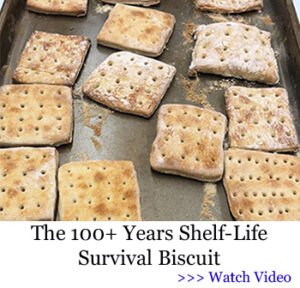
The basic Cold War version used:
- Bulgur wheat flour
- Water
- Salt (optional)
- That’s it
You mix it into a stiff dough, roll it thin, cut it into squares, and bake it at low temperature until it’s completely dry.
The key isn’t the ingredients, it’s the process.
Every bit of moisture has to be removed. That’s what gives it the indefinite shelf life.
But I’m going to level with you. The original government crackers tasted like cardboard soaked in sadness.
When Illinois officials tested old stockpiles in 1976, the smell caused coughing fits, and after one bite they canceled the experiment.
The Chicago Tribune said they’d be better as weapons than food.
Here’s what I do differently:
I’ve spent two years refining this recipe to make something that’s actually palatable while keeping the cost under 40 cents per day and maintaining that extreme shelf life.
I add honey for calories and preservation.
I use a small amount of oil to prevent the crackers from being quite so tooth-breaking.
I add cinnamon because life’s too short to eat flavorless survival food if you don’t have to.
The result?
Something that tastes like a bland graham cracker instead of punishment food.
My kids will actually eat these without complaint, which matters if you’re trying to feed your family in a real emergency.
Why This Beats Everything Else in Your Pantry
I know what you’re thinking. “Zach, I’ve got rice and beans. Why do I need crackers from the 1960s?”
Let me explain why this is different.
Weight matters. A day’s worth of these crackers weighs about 12 ounces. That’s nothing.
Try carrying enough rice and beans to feed yourself for two weeks.
You’re looking at 20+ pounds minimum, and that doesn’t include water for cooking or fuel for your stove.
These crackers?
You can fit a two-week supply in a backpack and still have room for everything else.
No cooking required. Rice needs water and heat. Beans need soaking and heat. Freeze-dried meals need boiling water.
These crackers? You open the container and eat them.
That’s it. No fire. No fuel. No risk of smoke giving away your position if you’re in a situation where OPSEC matters.
The cost is unbeatable. Let’s do the math. A 30-day supply of Mountain House meals costs around $300-400.
I can make a 30-day supply of these crackers for about $11.
Eleven dollars. That’s bulgur flour ($6), honey ($3), oil ($1), and salt (basically free).
Even if you triple the cost for Mylar bags and oxygen absorbers, you’re still under $20.
Storage is simple. Freeze-dried meals take up space, lots of it. A month’s supply fills two or three five-gallon buckets. These crackers?
They stack flat. I’ve got six months of emergency calories stored in a space smaller than a single milk crate.
The Real History Nobody Talks About
The government stockpiled these crackers in public shelters starting in 1961.
Cities stored them in aluminum cans in underground bunkers beneath city halls and schools.
The plan was for “shelterees”, that’s what they actually called survivors, to eat six crackers per day along with hard candy supplements for two weeks underground.
Then the Cold War ended without going nuclear, and everyone forgot about them.
By 1976, testing revealed most stockpiles had become rancid, and the Defense Civil Preparedness Agency ordered them destroyed.
But here’s what’s wild: In 2017, a Massachusetts city hall was overrun with millions of beetles that had been feeding on rotting crackers stored since the 1960s.
For decades, these things just sat there, forgotten in basements across America.
The government spent millions developing this food, produced 165,000 tons of it, and then just… moved on.
No one thought to preserve the actual value of what they’d created, an incredibly cheap, shelf-stable survival food that could feed people through any disaster.
That’s the government for you. Millions in R&D, zero follow-through.
How to Actually Make These at Home
You don’t need special equipment. You don’t need a fallout shelter.
You need an oven, a bowl, and about 90 minutes including baking time.
The ingredients for one batch (about 40 crackers):
- 2 cups bulgur flour
- 1/2 cup water (adjust as needed)
- 2 tablespoons honey
- 1 tablespoon oil
- 1/2 teaspoon salt
- 1/2 teaspoon cinnamon (optional but recommended)
Bulgur flour isn’t common in regular grocery stores, but you can order it online for dirt cheap or make your own by grinding bulgur wheat in a grain mill. I buy 25-pound bags for about $30, which makes hundreds of crackers.
The process:
Mix the dry ingredients in a bowl. Add the honey and oil, then gradually add water until you get a stiff dough, think pie crust consistency, not bread dough. If it’s sticky, you’ve added too much water. Add more flour.
Roll the dough thin on a floured surface, about 1/8 inch thick. Thinner is better for storage, but go too thin and they’ll fall apart. Cut into squares. I use a pizza cutter.
Poke holes in each cracker with a fork. This isn’t decorative, it prevents bubbling during baking and helps them dry evenly.
Bake at 250°F for 45-60 minutes, flipping halfway through. They’re done when they’re completely hard and dry.
Not just firm, hard. Like a dog biscuit. If there’s any give, they need more time. Moisture is the enemy of shelf life.
Let them cool completely before storing. Any residual heat means condensation in your containers.
Storage: Where Most People Screw This Up
I’ve seen people spend hours making perfect survival crackers, then store them wrong and watch them go rancid in six months.
Here’s what actually works:
Use Mylar bags with oxygen absorbers.
Not Ziploc bags. Not Tupperware. Mylar bags with 300cc oxygen absorbers.
The oxygen is what causes fats to go rancid and crackers to lose their crunch. Remove the oxygen, and these things will outlast you.
I seal mine in batches of 40 crackers per bag, that’s roughly a week’s worth at 6 per day. Label them with the date and contents.
Store in a cool, dark place. Heat and light are the enemy.
The reality check: Even with perfect storage, any recipe with oil will eventually go rancid. That’s chemistry.
The government’s original version had no oil and theoretically lasted indefinitely.
My version with added oil should last 3-5 years minimum, possibly longer. I rotate mine every three years to be safe.
If you want maximum shelf life, skip the oil entirely. Yes, they’ll be harder and less pleasant to eat.
That’s the trade-off. Only you can decide if an extra two years of shelf life is worth choking down cardboard.
What This Actually Costs You
Let’s break down the real numbers, because that 37-cent claim needs context.
My recipe:
- Bulgur flour: $1.20/pound = $0.30 per batch
- Honey: $0.20 per batch
- Oil: $0.05 per batch
- Salt and cinnamon: negligible
One batch makes 40 crackers. At 6 crackers per day, that’s 6.7 days of food for $0.55 total. That’s 8 cents per day.
Wait, that’s way less than 37 cents. Here’s why: I’m using bulk ingredients and modern prices.
The government was calculating based on 1962 dollars, commercial production costs, and packaging.
Adjust for inflation and the 37-cent figure would be over $4 today, still cheaper than any commercial option.
But here’s the honest truth about cost.
If you’re eating only these crackers, you’ll lose weight.
The 2,100 calories are enough to keep you alive and functioning, but not enough to maintain body weight for most adults doing physical work.
If you’re planning to do more than sit in a shelter, you’ll need to supplement with fats and proteins.
I use these as a base calorie source and add things like peanut butter, nuts, or jerky for complete nutrition.
That brings the daily cost up to about $1-2 depending on what you add, still dramatically cheaper than commercial survival food.
Testing: What I Learned the Hard Way
In 2023, I took these on a week-long primitive camping trip in Missouri.
No stove. No cooler.
Just these crackers, water, and whatever I could forage. It was my way of testing whether this food actually works under realistic conditions.
Day 1: These are fine. Kind of boring, but fine. I ate six for breakfast with some honey I’d brought separately. Felt full for hours.
Day 2: Starting to miss real food. The crackers are bland even with cinnamon. I tried soaking some in creek water to soften them. Bad idea, they turned to mush and tasted worse.
Day 3: Energy levels are good, but I’m hungry all the time. Not weak-hungry. Just constantly aware that I want more food. Caught some fish and cooked it over a fire. The combination of crackers and fish actually worked well.
Day 4: My mistake was not bringing enough salt. These crackers have minimal sodium. After days of sweating in summer heat, I was craving salt desperately. Lesson learned: if you’re doing physical work, you need extra sodium beyond what’s in the crackers.
Day 5-7: Routine set in. Six crackers for breakfast. Six for lunch. Six for dinner. Supplemented with whatever I could find or catch. Lost five pounds by the end of the week, but never felt weak or lightheaded.
The biggest takeaway? This food works. It’s not enjoyable. It’s not exciting. But it absolutely keeps you functional. In a real emergency where you’ve got bigger problems than menu boredom, these crackers deliver exactly what they promise, cheap, reliable calories that keep you going.
The Comparison Nobody Wants to Hear
I’m going to say something that’ll piss off the survival food industry. Most of what they sell you is overpriced garbage.
A 10-can case of Mountain House costs $300 and provides 90 servings.
That’s $3.33 per serving, and their “serving” is usually about 250 calories.
For 2,000 calories per day, you’re spending $26-30 daily.
These crackers? Less than a dollar per day for the same calories, and they pack smaller and lighter.
“But Zach,” you say, “Mountain House tastes good.” Sure.
And when you’re three days into a power outage, you know what else tastes good? Anything. Food is food when you’re genuinely hungry.
I’m not saying don’t buy commercial survival food.
I have some. It has its place for short-term emergencies when you want comfort.
But building a six-month food supply with commercial options will cost thousands of dollars.
Building it with homemade survival crackers costs under $200, including storage materials.
That’s not a small difference. For most families, that’s the difference between being prepared and not being prepared at all.
What the Cold War Taught Us (That We Forgot)
The government planners in 1960 understood something we’ve lost: survival food doesn’t need to be fancy. It needs to work.
They weren’t trying to create the perfect meal.
They were solving a logistics problem: how do you feed 180 million people when supply chains collapse?
Their answer was simple, strip food down to its absolute basics.
Maximum nutrition, minimum cost, indefinite storage.
We’ve gone the opposite direction.
Modern survival food is marketed like luxury items. Seventeen-year shelf life! Gourmet recipes!
Looks like real food! And you’re paying premium prices for packaging and marketing.
The government’s approach was described as “austere” but “adequate in accord with minimal survival concept”, bureaucrat speak for “it’ll keep you alive, but you won’t enjoy it.”
That’s exactly what emergency food should be. Not enjoyable. Not fancy. Just functional.

The Real Value of Dead-Simple Recipes
Here’s what I’ve learned over the past twelve years: the more complicated your prep, the less likely you’ll actually do it.
This recipe has four ingredients.
You mix them, bake them, store them. A ten-year-old could do this.
There’s no special technique. No secret method. No equipment you don’t already own.
Compare that to pemmican, which requires rendering fat and properly drying meat. Or home canning, which needs pressure cookers and perfect technique or you risk botulism.
Or freeze-drying, which requires a $2,000+ machine.
This recipe? Bowl, oven, done.
That simplicity is its superpower.
You can make these while watching TV. You can teach your kids to make them.
You can produce months of food supply over a few weekends without breaking your budget or your back.
The preparedness trap most people fall into: They research the perfect system, buy expensive equipment, plan elaborate food storage, and then never actually do it because it’s too complicated or expensive.
Dead simple beats perfect-but-never-done every single time.
What This Means for Your Prep Strategy
I’m not telling you to throw out everything else in your pantry and live on crackers.
I’m telling you to think about these as the foundation of your food storage, the cheapest, most space-efficient base layer that gives you time to figure out everything else.
Here’s my current strategy:
Layer 1: Homemade survival crackers, six months’ worth stored in Mylar bags. Cost: $150 including storage materials. Takes up minimal space. Never worry about it.
Layer 2: Rice, beans, oats, flour, sugar, salt, oil, standard bulk staples. Another six months of variety. Cost: $300-400. Requires more storage space and rotation.
Layer 3: Canned goods, freeze-dried vegetables, protein powder, things that improve nutrition and morale. Three months’ worth. Cost: $400-500. Regular rotation required.
Layer 4: Commercial freeze-dried meals, Mountain House, Peak Refuel, whatever. Two weeks’ worth for genuine emergencies when I need hot food fast. Cost: $200-300.
Total investment: About $1,200 for a year’s food security. Most of that cost is in layers 2-4.
The crackers, the most important foundation layer, represent only 12% of the total cost.
If you’ve only got $200 to spend on food storage right now, skip the fancy stuff. Make crackers.
You can produce six months of baseline calories for that budget and still have money left over for water filtration.
The Government’s Other Mistakes (And How to Avoid Them)
The survival cracker program failed for reasons that have nothing to do with the food itself.
Mistake 1: They didn’t teach people how to make them.
The government treated this as a top-down solution, they’d produce the crackers and distribute them.
When funding dried up in 1969, the whole system collapsed.
Nobody outside the program knew the recipe or process.
Mistake 2: They stored them wrong. Those aluminum cans in damp basements? Leaks caused the containers to crack and the crackers to rot. Proper storage matters more than the food itself.
Mistake 3: They didn’t build in any palatability. The crackers were famously terrible. One tester described them as “wood-like” with a “paint smell,” while another said they tasted like Ritz crackers left in a hot car for eight years. That’s a failure of vision. Survival food can be basic without being inedible.
Mistake 4: They had no rotation plan. Food was supposed to sit in shelters for decades untouched. That’s not realistic. Food storage requires rotation and testing, or you end up with a basement full of rancid crackers you can’t actually use.
My approach fixes all of these:
- I make small batches regularly, so it’s an ongoing skill, not a one-time project
- I store them properly in Mylar with oxygen absorbers
- I’ve adjusted the recipe to actually taste okay
- I rotate through them—use the oldest first, make new batches to replace them
What About “The Lost Superfoods” Book?
You’ve probably seen the marketing for this. “The secret Doomsday ration the government doesn’t want you to know about!” It’s everywhere in prepper circles.
Let me be straight with you: The book includes the Cold War ration recipe along with 126 other historical recipes.
Some of them are genuinely useful.
But you don’t need to buy anything to make these crackers. The basic recipe is public information.
The government’s version was declassified decades ago.
What you’re paying for with books like that is convenience, someone’s gathered and tested multiple recipes in one place.
If that’s worth the money to you, fine. But understand you’re not buying secret information. You’re buying collected research and testing.
I’ve got nothing against the book.
I actually own it. Some of the other recipes are interesting.
But don’t fall for the marketing angle that this is hidden knowledge the government is suppressing.
It’s historical research that got forgotten because the Cold War ended and everyone moved on.
When These Crackers Actually Make Sense
Let’s be practical about when this food is the right choice:
Bug-out bags: Absolutely. Nothing packs lighter or takes up less space. A three-day supply weighs maybe two pounds. Try that with MREs.
Get-home bags: Perfect. Stuck at work when disaster hits? These crackers and a water filter get you home safely.
Vehicle emergency kits: Yes. They handle temperature extremes better than most commercial options and don’t freeze in winter.
Basement food storage: Great as a foundation, but supplement with other foods for variety and complete nutrition.
Daily eating: No. Don’t do this. These are emergency food. They’re nutritionally adequate for short-term survival, not long-term health.
Trading/bartering: Possibly. In a long-term collapse scenario, people need calories. These are cheap enough to make extras for trade.
Everyday camping/hiking: Honestly, there are better options that taste better and provide more complete nutrition. Save these for genuine emergencies.
The Skills That Matter More Than the Recipe
Here’s what nobody talks about: the recipe isn’t the hard part.
Making the crackers is easy. What’s harder is building the habit of actually doing it.
I’ve met dozens of preppers who have the knowledge but haven’t made a single batch.
They’re waiting for the perfect time.
Or they’re going to do it next month. Or they’re researching better storage options first.
Meanwhile, they’ve got zero emergency food they actually made themselves.
The skill you need to develop: Making food prep a regular part of your routine, not a special project. I make a batch of crackers every month. Takes me 90 minutes. It’s as routine as mowing the lawn or doing laundry.
That consistency means I always have fresh crackers rotating through my storage.
I’m constantly practicing the skill.
And I’ve made over 50 batches at this point, so I know exactly how they behave in different conditions and storage methods.
Start small. Make one batch this weekend. See how it goes.
Then make another batch next month. That’s how you build real preparedness, consistent action, not perfect planning.
The Nutrition Reality Check
Let me address this head-on because it matters: these crackers alone are not a complete diet.
They’re primarily carbohydrates. Yes, bulgur has some protein (about 12-15% by weight) and fiber.
But you’re missing essential fats, complete proteins, vitamins C and B12, and various minerals.
The government designed them to be eaten with hard candy supplements for additional nutrients.
They understood these crackers were a baseline, not a complete solution.
For short-term emergencies (1-2 weeks): The crackers alone will keep you functional. You’ll survive. You won’t feel great, but you’ll make it.
For long-term situations (months): You need to supplement. Add:
- Fats: peanut butter, nuts, olive oil
- Complete proteins: canned meat, fish, protein powder
- Vitamins: multivitamin tablets, dried fruit
- Minerals: salt, electrolyte powder
The crackers become your base calories, the cheap, reliable foundation. Everything else fills in the nutritional gaps.
What I’d Do Differently If I Started Over
After six months of making these and two years of testing them in various scenarios, here’s what I’d change if I went back to 2022:
I’d start with smaller batches. My first attempt made 200 crackers. I didn’t know yet if I’d like them or if they’d store well. That was stupid. Start with a single batch, test it, refine your recipe and process, then scale up.
I’d invest in a grain mill earlier. Buying bulgur flour is expensive compared to buying whole bulgur wheat and grinding it yourself. A decent hand-crank grain mill costs $100-150 and pays for itself after about 40 pounds of flour.
I’d test different flours. Bulgur works great, but so does whole wheat flour or a mix of different grains. Each has different nutrition profiles and storage characteristics.
I’d experiment more upfront instead of sticking religiously to bulgur just because that’s what the government used.
I’d make them thinner. My early batches were too thick, easier to work with, but they took up more storage space and were harder to eat. Thinner crackers are more fragile but pack better.
I’d skip the cinnamon at first. I added it thinking it would help with taste. It does, but barely.
I was trying to make survival food taste good instead of accepting it for what it is. Save the cinnamon and just make basic crackers.
If you want flavor, add it when you eat them.
The Psychology of Food Security
Here’s something that surprised me: actually having these crackers stored changed how I think about emergencies.
Before I made them, emergency food was always this vague anxiety in the back of my mind.
I had some canned goods.
Some rice.
A few boxes of pasta. But I had no idea if it was enough.
I hadn’t done the math. I definitely hadn’t tested whether I could actually survive on it.
After making 180 days’ worth of crackers and properly storing them, something shifted.
I wasn’t worried anymore about whether my family would have food in a disaster.
I knew we’d have food. It was real. It was tangible.
I could see the bags stacked in my basement.
That certainty changed everything. I could focus on other prep areas, water, security, medical supplies, without constantly circling back to “but what about food?”
The lesson: Actually doing the prep is more valuable than perfectly planning the prep.
These crackers aren’t perfect. But they’re done. They’re real. They exist in my storage room right now, ready to use.
That’s worth more than having the perfect food storage system still on my someday list.
Start Now, Not Later
Look, I could keep going. I could tell you about the different storage tests I ran.
I could detail the nutritional analysis I did with a dietician friend. I could explain eighteen different variations on the basic recipe.
But that’s not what you need.
What you need is to stop reading and start doing.
The best time to build your food storage was ten years ago. The second-best time is today.
Not next weekend. Not when you have more money. Not after you research better options.
Today.
Make one batch of crackers this week. It’ll cost you maybe $5 in ingredients you probably already have. It’ll take you 90 minutes including baking time.
You’ll end up with 40 crackers, enough for a week of emergency calories.
That’s one week more food security than you have right now.
Do that once a month for six months, and you’ll have a foundation food supply that’ll carry your family through almost any disaster.
For less than the cost of one date night.
The government spent millions figuring this out in 1960.
They solved the problem of how to feed millions of people for pennies a day.
Then they forgot about it because the bombs never fell.
Don’t make the same mistake.
The bombs might not fall, but plenty of other disasters will. Economic collapse.
Supply chain failures. Natural disasters. Job loss. Medical emergencies.
You don’t need fancy freeze-dried meals for those scenarios.
You need reliable calories at prices you can afford.
That’s exactly what these crackers provide.
Stop waiting for permission.
Stop waiting for the perfect moment.
Stop waiting for more information.
Go make some crackers.